


Artificial intelligence (AI) is bringing striking improvements to customer service. The challenge, however, is that many organizations still don’t know how to make practical use of it. The excitement is real, and daily uses are varied. However, the true business value is slow to reach many companies.
To use AI effectively, it takes a deeper understanding of the mechanisms behind it. This article explores what Large Language Models (LLMs) and Machine Learning (ML) can accomplish in customer service.
What Are LLMs and ML—and How Do They Work?
Large Language Models and Machine Learning algorithms are transforming customer service. They are becoming important tools for companies. These tools help them stay competitive, provide quick support, save time, and keep high performance.
What Are Large Language Models?
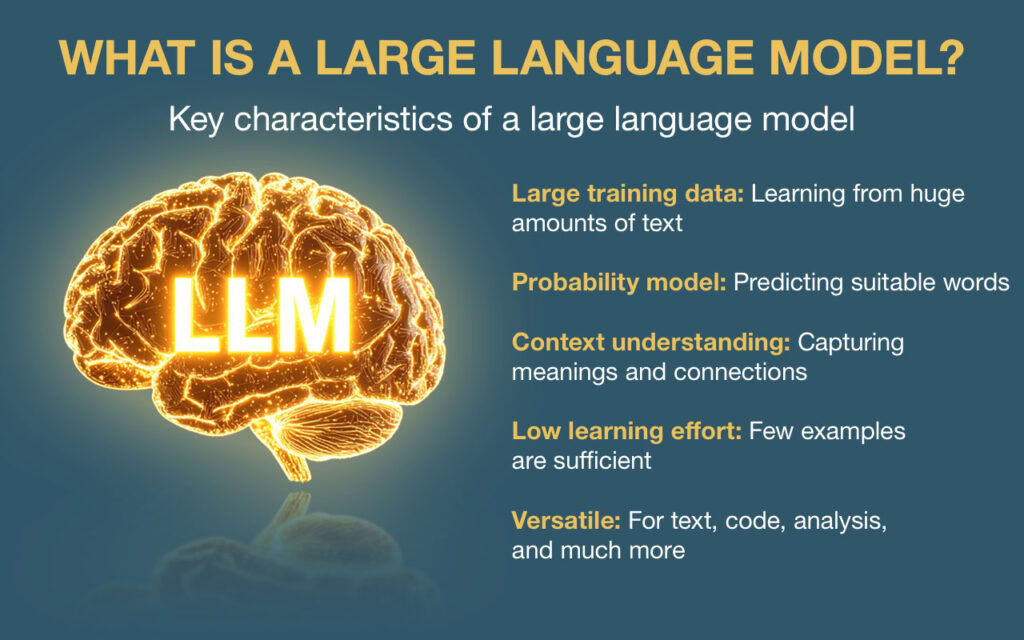
Large Language Models (LLMs) are a powerful type of artificial intelligence (AI) designed to understand and generate human language. They are machine learning models that process natural language (Natural Language Processing – NLP).
LLMs understand text, analyze it, and generate coherent responses or perform language-related tasks. Neural networks that are similar in design to the human brain make this possible. The network’s training process requires massive amounts of text so that the model can learn and build connections.
There are many types of models that are differentiated by how the model is trained.
Fun Fact #1: To read the amount of text used to train GPT-3, a human would need to read around the clock for 2,600 years.
Fun Fact #2: A large language model performs many calculations. If a human could do one billion operations each second, it would still take over 100 million years.
When it comes to handling text, LLMs can:
- Generate text
- Create summaries
- Continue or extend text
- Translate languages
- Rephrase sentences
- Classify data
- Categorize topics
- Detect sentiment (Sentiment Analysis)
- Fraud detection
They also function as chatbots, answer questions, and can even perform basic programming tasks.
These capabilities make LLMs increasingly popular in the business world. They support customer service with chatbots, sentiment analysis, translations, summaries, and information delivery.
What sets them apart: In 2017, developers introduced transformer models. This was a game changer because it lets LLMs decide how important information is in a sequence. It also processes NLP-related information much faster.
Use in business: In addition to training one’s own LLM, companies can be licensed. This means that the LLM can provide usable results right out of the box.
Companies can improve a pre-trained model by adding specialized data. This helps the model fit specific tasks, industries, or language styles. This results in more precise and context-aware outputs.
What Is Machine Learning?
Machine Learning (ML) is the foundation of Large Language Models. ML-based programs learn from example data rather than being explicitly programmed with rigid data. These models learn to recognize patterns and apply them to new data without needing additional instructions.
After the initial learning phase, it is fine tuned. Reinforcement learning is used. This is the practice of teaching the model which, among multiple options, is the best fit. The algorithm learns to make better decisions over time.
A simple example: A program initially doesn’t know what a cat looks like. The program learns from thousands of images and can later recognize a cat without being told what it looks like.
A more advanced example is sentiment analysis. A model learns how different emotions are expressed through various sample data and can then detect customer sentiment. This gives support agents quick orientation, allowing them to dive deeper into critical cases and respond accordingly.
Learn how OTRS makes your support more efficient with its AI services and download the OTRS AI data sheet.
Background: LLMs and ML Are on the Rise
Artificial intelligence continues to gain momentum. The challenge is not in understanding its potential but in turning that potential into tangible business outcomes. Yet, teams have difficulty applying tools, like ChatGBP, in meaningful, business-specific ways.
Our report is called “The State of SMB IT for 2026” It shows that 71% of small and medium-sized businesses (SMBs) believe AI is important for their IT service management (ITSM) success. However, most are still just starting to adopt it. For SMBs, AI is less of a disruptive force and more of an enhancement to existing workflows.
According to the report, the adoption of AI systems correlates with ITSM maturity. Without a good ITSM or ITAM system, AI has limited uses. It would only be able to help with chatbots, sorting tickets, or creating knowledge base articles.
AI, LLMs, and ML are already making a difference in service management. They are providing clear efficiency gains.
The bottom line: These technologies currently support manual processes rather than fully replacing them.
Role in Customer Service
Large Language Models are an excellent fit for customer service. Put simply: LLMs can significantly optimize customer service. These AI-driven applications support a wide variety of tasks and make a real difference.
Customers get fast and helpful answers. Agents save time and effort. Businesses enjoy smoother processes, more productive workers, and happier customers.
Example Use Case
This even applies to complex cases. Imagine a customer who is referring to issues following the implementation of a particular software. The assigned agent can quickly summarize past ticket interactions using AI. They can also detect the customer’s mood with sentiment analysis.
Additionally, they receive a suggested response in just seconds with the agent just needing to review it.
In such cases, the time savings are enormous, and the results—thanks to a combination of AI tools—are likely to be highly helpful.
Even without agent involvement, LLMs are taking on a key role by responding to inquiries instantly. They are able to offer around the clock services. This relieves staff and automates routine tasks. Chatbots and AI-driven knowledge bases are great examples of this.
Progress Through Machine Learning
Machine learning doesn’t just represent the potential of LLMs—it powers their ongoing evolution. LLM-generated outputs may start by handling simple questions, like service-level 0 or service-level 1 inquiries. However, their abilities can improve. They can eventually deal with complex issues and match the skills of experienced workers.
Tips for Using LLMs and ML
There’s no doubt about it: LLMs and ML are growing quickly. They are getting great results and will likely exceed our expectations in the future.
Therefore, the question isn’t whether to use these technologies—but how. In other words, getting the most out of LLMs and ML is crucial both now and in the future.
Below are practical tips for leveraging their strengths while effectively addressing challenges.
Make the Most of the Benefits
The potential benefits of AI are vast, powerful, and varied. You just need to know them—and know how to use them.
Here are key examples of how LLMs can drive meaningful improvements in customer service:
#1 Use LLM Capabilities Strategically for Automation
Many users apply LLMs in a fragmented way, supporting manual processes. In reality, LLMs can fully take over tasks that previously required manual effort. For example, in customer service, models can generate responses, handle entire support conversations, and even automate documentation or FAQ creation.
Ideally, users who understand the full scope of LLM capabilities should use them to the fullest extent possible. This saves time and often yields more consistent and better results.
#2 Enhance Precision and Quality
LLMs are often recommended for routine tasks, process automation, and increasing output. Advanced machine learning allows for high quality. LLMs not only understand language well but can also generate it accurately. This makes it possible to produce well-crafted emails and reports, clear summaries, rewrites, and accurate translations between languages.
#3 Find Creative Solutions and New Ideas
Thanks to their vast training data, LLMs can surface knowledge from many different areas and connect the dots. This can lead to creative, unconventional solutions and ideas that users wouldn’t come up with on their own.
Overcoming Challenges
In general, AI, LLMs, and ML offer significantly more advantages than problems. Still, there are some challenges. The sooner users understand them, the better they can manage them.
Here are the most common challenges users face:
- Determining whether they can trust the outputs
- Difficulty validating AI decisions or recommendations
- Dealing with bias and discrimination
- Protecting sensitive data
- Navigating legal and ethical uncertainties
Below are a few key challenges explained:
#1 Dealing with Hallucinations
One of the biggest challenges in generative AI is output accuracy. While most results are factual, people should still check the outcomes—especially in complex scenarios.
Sometimes AI “hallucinates”—generating information that sounds right but is factually incorrect. This happens because predictions are based on probability (the most likely next word) rather than truth verification.
You can reduce hallucinations by providing LLMs with context—such as relevant documents—which helps generate more accurate, context-aware responses.
#2 Identifying Bias
This challenge is closely related to accuracy. Biases may be factually correct but still present a skewed view of reality.
For instance, LLMs can reproduce social stereotypes—like defaulting to male doctors and female nurses. In addition to ethical bias, linguistic (e.g., overly polite wording) or geographic (e.g., US-centric examples) bias may appear.
With experience, users can easily identify these. Mature applications and diverse training data help minimize them—especially with fine-tuning using curated datasets.
#3 Protecting Sensitive Data
LLMs should comply with data protection regulations like the GDPR and must not expose personal data. Users should avoid sharing personal or sensitive data unless absolutely necessary—and then only if they’re sure how that data is being handled.
LLMs and Machine Learning at OTRS
Today’s customers expect outstanding service experiences: fast, knowledgeable, thorough, and up to date. In ITSM, that includes being able to handle large ticket volumes while maintaining high service quality and satisfaction.
OTRS’s AI services bring LLMs and machine learning to the next level. Our AI learns from data, understands context, and generates relevant answers—automating previously time-consuming service tasks.
This improves efficiency and the quality of customer service. It also helps businesses grow, giving them a clear edge over competitors.
Available AI services include:
- Ticket classification and service description
- AI-generated responses
- Sentiment analysis
- Real-time translations
- AI-generated summaries
Conclusion
Large Language Models and Machine Learning are becoming increasingly important in customer service. When used for automation, standardization, or personalization, they can significantly enhance efficiency, customer experiences, and satisfaction.
It’s not just about saving time on routine tasks. It’s also about quality.
LLMs provide new insights and effective solutions. They also offer sentiment analysis. These create a strong base for better service.
In the future, a key differentiator will be how businesses use LLMs. There are two main approaches:
- LLMs as supportive tools – used occasionally to speed up and enhance manual processes.
- LLMs as disruptive technology – used to replace manual processes altogether.
The first approach keeps the focus on manual labor; the second is technology-driven. The truth is that businesses using LLMs only sometimes are just starting to see their full potential in customer service.