

Every serious improvement starts with a reality check. To get closer to their goals step by step, companies must reliably identify where they stand and where they want to go.
In fact, many companies overestimate their ITSM maturity level. Most are still in a relatively early stage. In other words, there’s still huge potential for growth. Big leaps can be made with just a few activities.
So where do you really stand with ITSM (or ESM; Enterprise Service Management)? By using the following ITSM assessment, you will quickly and easily find out.
Background
Determining ITSM maturity may sound technical, but in practice it’s quite simple. Maturity essentially reflects the extent to which organizations have developed their ITSM. It shows how effective and goal-oriented their service management capabilities are. It also indicates areas for improvement.
What does ITSM maturity mean?
ITSM maturity describes an organization’s ability to use ITSM in line with industry standards. It helps identify areas on which to focus in order to provide a better customer experience.
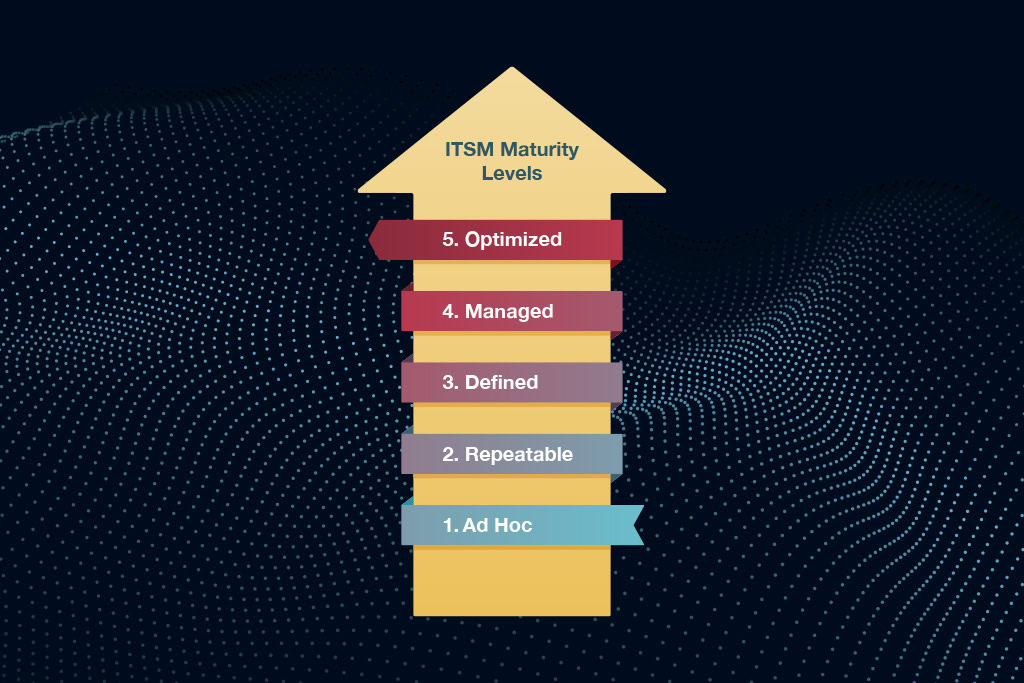
A maturity matrix (as shown below) provides valuable guidance. Using a scale, organizations can evaluate and compare their ITSM maturity.
The five key maturity levels are:
- Level #1: Ad hoc
- Level #2: Repeatable
- Level #3: Defined
- Level #4: Managed
- Level #5: Optimized
Why is ITSM maturity important?
It is essential to know your level of ITSM maturity. This is an essential prerequisite for continuous process improvement, achieving business objectives, and leveraging IT as a strategic resource.
In short: those who know their level of ITSM maturity have a solid foundation to optimize practices, achieve success, and turn ITSM into measurable results.
Study: The State of SMB IT for 2026
Our study is called The State of SMB IT for 2026. It provides exclusive data on the ITSM maturity of small and medium-sized businesses (SMBs). It is based on an online survey conducted between March 14 and April 4, 2025, commissioned by EasyVista and OTRS AG.
A total of 1,051 executives and IT professionals were surveyed. They work in companies ranging from 51 to 1,000 employees. The companies are located in Brazil, Germany, France, the UK, Italy, Spain, Hungary, Portugal, Malaysia, Mexico, and the US.
ITSM maturity: The status quo
Most SMBs are still in relatively early ITSM maturity stages, relying on fragmented tools and reactive approaches. Only 12% describe their ITSM approach as fully mature and proactive.
Forty-nine percent report well-structured processes. Twenty-six percent have partially structured processes, and 12% still operate with ad hoc, reactive procedures. In contrast, 56% view ITSM as a strategic driver of business success.
This highlights a significant gap between reality (early development stages) and ambition (using ITSM for strategic goals and efficiency). Many SMBs find themselves at a dead end. They are aware of the need for modernization but are hindered by low investment and legacy technologies.
Outlook
ITSM is increasingly becoming a strategic driver for business success. This makes achieving a higher maturity level a necessity.
The outlook for SMBs is mixed. New opportunities, such as AI integrations and automation, could help them achieve more efficient service delivery. On the other hand, challenges like fragmented tools, limited budgets, and lack of staff continue to hold them back.
The path forward does not necessarily depend on high IT budgets. Rather, it’s about taking targeted action: improving workflows, equipping teams with the right tools, and enhancing security.
In other words: achieving the highest possible level of ITSM maturity is crucial. It can unlock success without massive investment.
The formula for success: Improve existing processes purposefully instead of starting over repeatedly.
The 5 Dimensions of Service Management ITSM Maturity
ITSM maturity is multi-layered though not overly complex. It is derived from the ITIL maturity model. It is a multidimensional model that covers the following:
- Process maturity: Are there clearly defined, consistent processes? Is automation in place? Are KPIs being measured? Are processes reviewed and optimized regularly?
- Governance & strategy: Does ITSM measurably support business goals? Is there a service catalog and SLAs? Are responsibilities clearly defined (e.g., service owners, process owners)? Are compliance and risk management integrated?
- Organization & culture: Do employees have the necessary ITIL, automation, and security skills? Does IT work in silos or cross-functionally with other departments? Are employees included in change management? Are self-service portals being used?
- Technology & tools: Are advanced features such as a CMDB, automation, and AI capabilities in use? Are portals user- and mobile-friendly? Are simple requests already automated?
- Measurement & outcomes: Are metrics in use, such as First Contact Resolution, MTTR, SLA compliance, or change success rate? Does IT deliver concrete business value? How is customer satisfaction measured (feedback, NPS, CSAT)? How proactive is IT (e.g., preventive root cause analysis)?
Examples of ITSM maturity in practice
#1: Extreme example of low maturity
With very low ITSM maturity, processes are ad hoc, chaotic, reactive, undocumented, and highly person-dependent. There’s no clear strategy or accountability, silos dominate, and collaboration is limited. Tools are used in isolation, and issues are only addressed reactively.
The first step here would be to document and standardize processes.
#2: Positive example of very high maturity
Here, processes are optimized and highly automated. Processes are innovative and value-driven.
Additionally, ITSM is closely aligned with business goals and measurable results, with excellent service as the guiding principle. AI-powered methods and advanced integrations are in use. Business value is delivered reliably and cost-effectively.
ITSM maturity matrix
Evaluating your own ITSM maturity may seem quite complex. It can be done relatively easily by using a schematic approach.
To do this, assign the following five dimensions to each of the five maturity levels (stages) – ad hoc, repeatable, defined, managed, and optimized.
A maturity model can be used in practice by rating each dimension—processes, governance, organization, technology, results—on a scale of 1 to 5. This clearly shows where the respective strengths and weaknesses lie.
Calculation examples
On this basis, ITSM maturity can be quantified and compared with concrete numbers. Scores range from 5 to 25. If each dimension scores 1 (5 * 1), the lowest maturity level of 5 is reached. With all top scores of 5, the ideal maturity of 25 is achieved.
However, scores are not necessarily consistent across dimensions. For example:
4 + 2 + 3 + 5 + 2 = 16 (medium maturity)
This example is realistic but not a benchmark. Maturity is highly individual and should mainly help define the next logical ITSM steps.
It is not unusual to see mature processes paired with a weak ITSM strategy. Another example is advanced technology combined with an underdeveloped organization.
Tip: If certain areas matter more than others, you can apply weighting to dimensions. For example, processes often carry greater importance, which can be reflected by a higher weighting factor.
Perspective
It’s best not to treat ITSM maturity too concretely. Instead, the matrix should serve as a practical tool for several key purposes:
- Gain a valid, quantified evaluation of ITSM’s status quo.
- Have sufficient data to enable comparisons with peers and competitors.
- Most importantly: identify the next logical steps and align them with business goals.
- Refer to the matrix for continuous improvement efforts.
Conclusion: ITSM maturity reveals opportunities
In a perfect world, no one would need an ITSM maturity model. Everything would already be optimized and automated. But perfection only exists in theory. In reality, most organizations are still in early development stages.
The goal of maturity assessment is clear: to provide insights into the meaningful next steps and goals. Unlike a simple benchmarking tool, it’s a powerful instrument for driving continuous improvement. Conversely, it can also show where no optimization is needed.
Often, however, there’s significant room for improvement. A lower maturity level should be seen as an opportunity. It offers evidence of untapped potential to make ITSM processes more efficient and more valuable to the business.
Learn how OTRS can help you optimize your ITSM.