
Expectations and reality often differ. With intelligent Service Level Management (SLM) – also called service quality management – a different picture emerges: this way, service providers and their customers know exactly which services must be delivered and to what extent.
In IT Service Management (ITSM), support from a ticketing system is necessary to fully meet customer expectations. This article shows what the right software features can accomplish so that both customers and service providers feel clarity and complete satisfaction.
Definition: Service Level Management (SLM)
Service Level Management defines, negotiates, and optimizes the delivery of IT services. It also monitors the service provider’s ability to meet the promised service levels and generates reports about them.
The overarching purpose of this ITIL® discipline is to continuously adapt IT services to customer expectations.
Benefits that Service Level Management (SLM) provides
Here is a brief outline of how advanced Service Level Management benefits service providers and their customers.
Benefit #1: Ensuring customer satisfaction
Customers generate revenue for companies that want to ensure their satisfaction. This is achieved precisely and effectively with Service Level Agreements (SLAs):
- Customers define clear requirements and expectations.
- Companies define their services and the criteria for fulfilling them precisely.
The major advantage: the services and their costs are absolutely objectively traceable, leaving no inconsistencies or room for debate.
Tip: The exact timeframe in which customers can expect a response and a solution should be clearly established. Differentiating by communication channel makes sense, as customers expect faster responses in chat than by email.
Benefit #2: Minimizing risks
Because IT services and the related tasks are clearly defined, providers run little risk of overlooking anything. This prevents potential downtime for customers and potential sanctions or penalties for service providers.
- Regular reporting and KPIs act as an early warning system for detecting and correcting deviations early.
- Effort can be realistically assessed and responsibility clearly assigned.
- By continuously monitoring service quality, potential weaknesses can be identified at any time.
“The best customer service is when customers don’t need to call you, don’t need to speak to you. It just works.”
Jeff Bezos
Founder of Amazon
Benefit #3: Controlling costs
Once Service Level Agreements are concluded with customers, they can serve as the basis for current and future needs. This makes clear which costs – both technical and personnel-related – can be expected.
This allows service providers to plan precisely and keep costs within the right scope: IT services are neither underutilized nor insufficiently equipped (i.e., overloaded).
Tip: Despite internal cost optimization, one should never lose sight of the customer’s costs. For example, if a premium customer suffers downtime or delayed problem resolution due to cost savings, it is extremely counterproductive.
Benefit #4: Continuous improvement
Clarity is the mother of improvement. With clear agreements and shared value creation, service providers and customers can use their resources efficiently. Over time, this leads to high efficiency for all parties involved.
Tip: With well-developed SLAs, all parties can communicate with transparency. This enhances the communication culture and acts as a useful tool to encourage improvements. It is paradoxical, but precisely because SLAs are binding—and therefore central—they serve beautifully as a starting point for relevant optimizations.
Service Level Management in the Ticketing System
With the right ticketing system, Service Level Management can fully demonstrate its value. Without appropriate software support, this process cannot be built in a sound and purposeful way.
The right software supports SLM in two ways:
- It provides views that give insight into Service Level Agreements.
- Many features indirectly support Service Level Management.
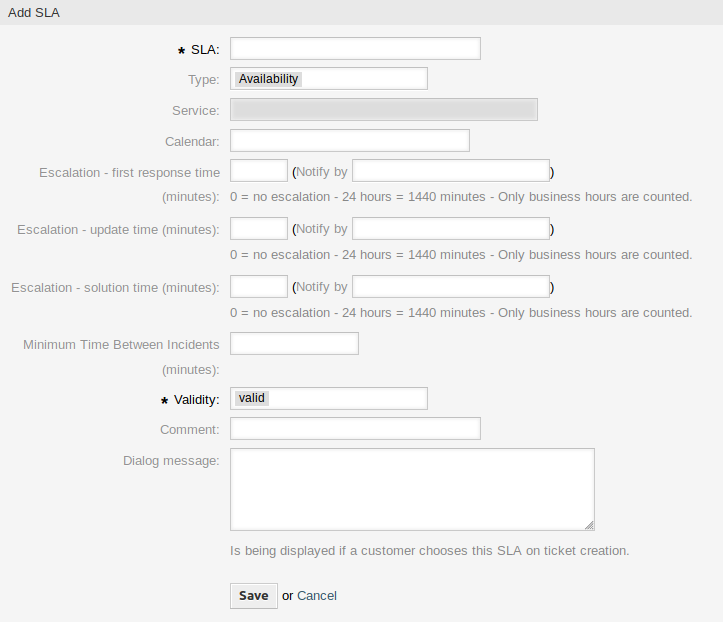
Service-Level-Management Views
Specific views make it immediately clear what the current status of Service Level Management is, which actions are necessary, and how different elements relate to each other.
- Information about a service level agreement is displayed.
- It provides insight into timeframes related to a Service Level Agreement.
- It lists services that may require action—indicated by statuses such as warning or incident.
- It displays the services linked to the respective Service Level Agreement.
Features that support Service Level Management
There are several features and functionalities in ticketing systems that are beneficial to Service Level Management. These form the foundation for building a dedicated SLM.
- Through a clear IT Asset Management (ITAM) system and the Configuration Management Database (CMDB), all IT assets and their relationships are visible. This provides an excellent overview during issues, helping reduce resolution times, meeting promised service times, and preventing incidents and problems.
- Automatic time tracking in Time and Quota Management helps you meet agreed-upon time commitments in a reliable and verifiable way.
- With comprehensive escalation management, even complex cases can be resolved quickly enough to meet Service Level Agreements, as they are rapidly escalated to the appropriate contacts.
- An IT service catalog is similar to a restaurant menu. Services can be assigned SLAs, including automatic SLA selection based on agreements.
- Traceability is the only way to clearly prove the adherence (or non-adherence) to Service Level Agreements. Audit and compliance functions provide a complete history of relevant events and seamless documentation.
How OTRS supports Service Level Management
OTRS offers flexibly definable services and SLAs with clear response, update, and resolution times. A precise escalation system displays deadlines and automatically sends warnings in case of (impending) violations.
Workflows—such as forwarding or escalations—can be automated via the Generic Agent. SLA information is visible directly in the ticket, while reports and dashboards provide a quick overview of SLA fulfillment. The service catalog and CMDB also give a clear view of services and their dependencies.
Conclusion
Service Level Management (SLM) often seem somewhat complicated, but only to a certain extent: Service Level Agreements specify what type of service the provider must deliver by when and how the service recipient compensates for it. SLM defines, optimizes, and monitors this process.
In ITSM, with a multitude of interwoven services, the standard approach leads through dedicated software support. Various features and functionalities assist in this process, either developed directly for Service Level Management or indirectly supporting it.