
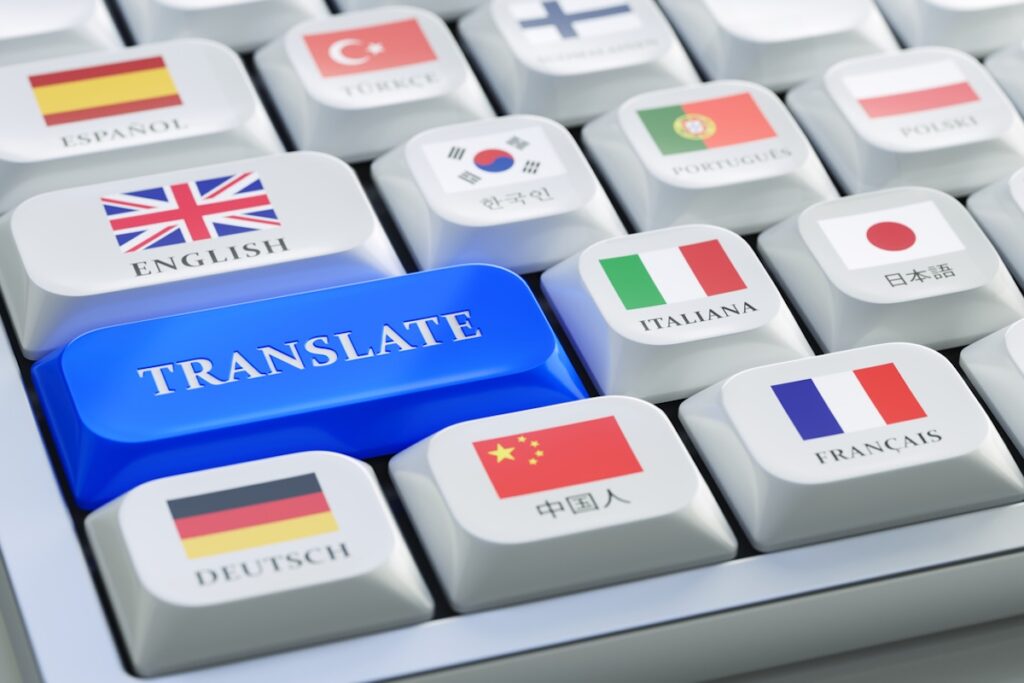
Different languages have always posed challenges — in customer service and ITSM just as much as in many other fields. As companies and their customer bases become increasingly international, people from a wide variety of linguistic backgrounds and with different levels of language proficiency must communicate and collaborate.
In the worst case, language barriers can make communication nearly impossible. But even before reaching that point, serious issues can arise. Misunderstandings may occur when one or more people in a conversation are not communicating in their native language — especially when the topic involves complex details or requires deep understanding.
In short: some problems can only be solved through intelligent, system-driven translations. Beyond that, a professional translation management system saves both time and effort.
This article highlights the advantages of a well-designed translation management feature within a ticketing system and explains how OTRS makes handling multiple translations simple and efficient.
Context: Why Effective Translation Management Matters
For international companies, managing language diversity can be a real challenge. They need to ensure multilingual communication and a high level of understanding among employees and customers — while maintaining consistency, which automation can help guarantee.
Speed is also a decisive factor in support environments. Agents must be able to manage requests efficiently and respond correctly right away. When this happens, employees save time and customers enjoy a smoother, more satisfying experience.
Clear, accurate, and well-structured translations provide tangible value on both sides: for employees and for customers. They also help prevent misinterpretations and misunderstandings that can otherwise lead to embarrassing or costly errors.
Even smaller benefits, such as shorter processing and resolution times, translate into lower opportunity costs for companies and better service for customers.
Here are some key takeaways:
- Effective translation management is a key element — alongside AI features and automation — of a modern, advanced service management solution.
- Translation management is a major advantage of modern OTRS features over the ((OTRS)) Community Edition.
- A well-developed translation system provides benefits similar to AI-based summaries: both improve clarity, understanding, and efficiency.
The Advantages of Advanced Translation Management
Fast and accurate translations deliver significant value. When organizations can easily view and manage information in multiple languages, they can communicate clearly and respond to issues quickly and effectively.
This also helps avoid opportunity costs by preventing misunderstandings and dissatisfaction. Poor, incomplete, or missing translations can quickly lead to frustration — both for customers and staff.
Below are the most important advantages of fast, high-quality, and comprehensive translations:
1. Major Time Savings
Being able to create multiple translations quickly and easily greatly reduces time and effort. This is especially valuable for multilingual companies aiming to boost productivity and efficiency. The benefits go beyond time savings — translation quality also remains consistently high.
2. Consistency
Texts and conversations often vary in tone or nuance across languages, especially when translations are not based on a unified foundation. When a system displays multiple languages side by side, the translations stay aligned and consistent. This helps prevent confusion, increases clarity, and saves additional time.
3. Less Repetitive Work
A key feature here is batch creation — generating multiple translations at once. Administrators can create translations for several languages in a single step, eliminating repetitive manual processes and speeding up multilingual content creation.
4. Scalability
Businesses shouldn’t be limited to local markets. To expand into new regions, language barriers must not become obstacles. With the ability to easily add and manage new language versions, companies can scale freely and efficiently.
5. Better User Experience
When translations are easy to create and manage, users benefit the most: they enjoy consistency, clarity, and a clear overview across languages. Any change made in one language is immediately applied to all others, keeping all translations synchronized and up to date — ensuring timely and accurate content across every supported language.
Translation Management in OTRS
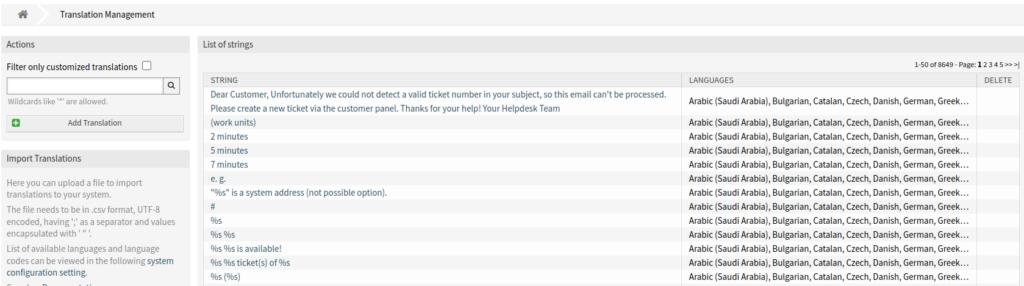
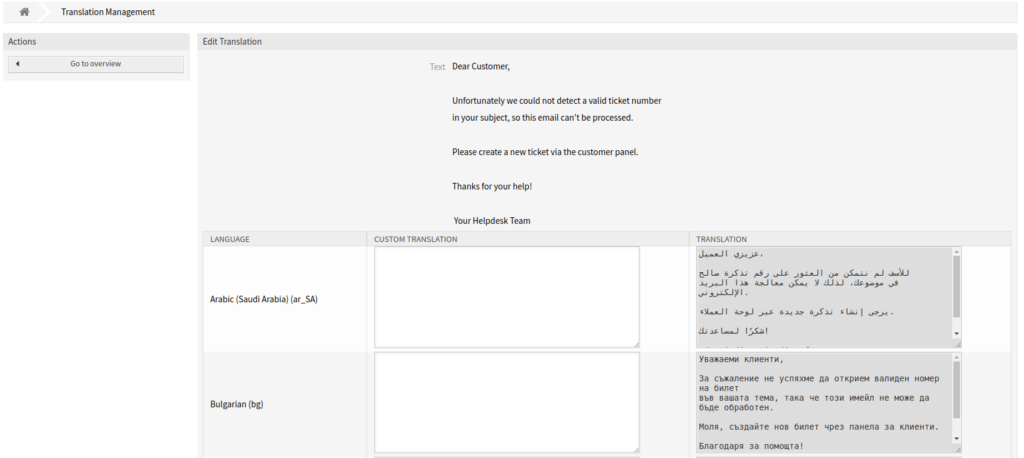
In OTRS, administrators can extend their admin interface with the translation management feature, allowing them to create translations easily — without switching between individual language views.
Within the admin area, predefined terms for translations are available. Users can simply select and fill in these terms, or alternatively, define their own manually.
Translations can be generated dynamically via templates or through import functions to provide content in multiple languages. OTRS offers predefined text modules for elements such as brand names, dynamic fields, explanatory notes, or process descriptions. These system terms — meaning the terminology used throughout OTRS — can now be translated consistently and efficiently.
Translations can also include industry-specific terminology. Known system terms can even be customized.
In short, customers can now fully adapt their systems to their preferred professional vocabulary.
Technically, translations are possible for all languages, with around 60 currently available out of the box. Additionally, any user can propose translations through our public portal.
As a result, workflow management for multilingual content becomes significantly easier. Key characteristics include a unified interface for a clear overview, consistent terminology, and the ability to generate multiple translations simultaneously.
Looking Ahead: AI-Based Translations
In the future, OTRS will include AI-powered translation capabilities. This will specifically extend to communication content (such as ticket conversations), allowing for automatic, real-time translation.
This upcoming AI-driven translation service — with all the benefits mentioned above — will bridge language barriers by instantly translating both incoming and outgoing ticket messages into the target language. This ensures smooth, immediate communication across different languages.
Agents will work more efficiently and save time, while customers enjoy consistent, high-quality service in their native language.
Translation Management will streamline workflows without requiring special permissions or technical knowledge. At the same time, the AI service will make communication effortless: all users will be able to read important messages in their own or preferred language.
The service will be available via our AI Credit System.
In addition, OTRS users can take advantage of other powerful AI-based features such as intelligent ticket classification and AI-assisted response generation.
Conclusion: Good Translations Optimize Service
A well-thought-out translation management system is essential for delivering consistent, balanced, and responsive service — or simply for effective communication within international organizations. It’s about more than overcoming language barriers: it’s about ensuring clarity, precision, and true mutual understanding.
Within a ticketing system like OTRS, clear and easy-to-create translations across many languages offer major advantages — from time savings and faster request handling to greater overall clarity that leads to customer satisfaction, and ultimately, stronger loyalty.