
Achieving more with fewer resources is the mandate. Yet, IT leaders in every organization must successfully and competitively manage the company’s technological infrastructure.
Cloud migrations are becoming more important. Companies are also digitalizing many departments. The demands and costs are high. They seek different software tools, solutions, and other IT components.
At first, it might seem enough to look only at direct expenses. These include software licenses and hardware costs. However, true cost efficiency comes from a more complex idea: the Total Cost of Ownership (TCO).
This article explains the idea of TCO. It shows how to consider it effectively. It also demonstrates how Enterprise Service Management (ESM) can help lower IT costs. This approach can provide a good return on investment (ROI).
What is TCO?
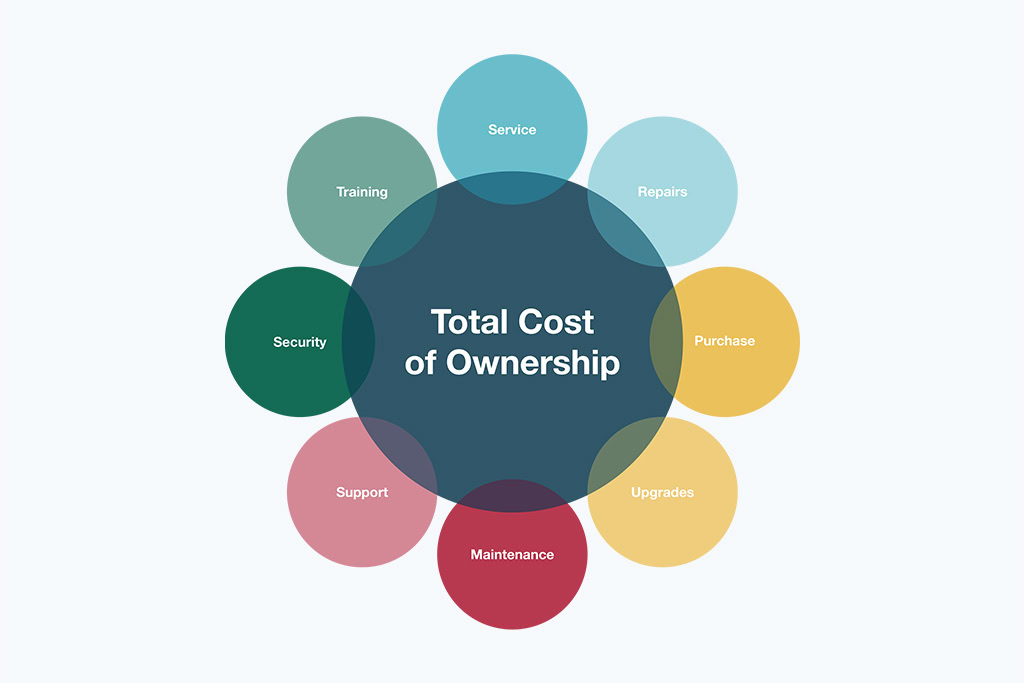
Total Cost of Ownership (TCO) is a financial calculation. It looks at both the direct and indirect costs of a product or service.In IT, this includes the purchase price of software, hardware, or services. It also covers costs for implementation, operation, maintenance, and decommissioning.
It is the result of a cost of ownership analysis. To calculate TCO in the IT environment consider:
- Acquisition and implementation costs: the initial purchase price, licenses, hardware purchase, configuration, and installations
- Operating costs: personnel costs, training, updates, support, security, energy consumption
- Indirect costs: downtime, inefficiencies, vendor lock-in, scalability limits
- End-of-life costs: migration, disposal, data decommissioning
TCO provides a holistic view on the lifecycle of an IT investment—far beyond the initial costs.
This perspective is crucial, especially in complex environments where services affect multiple departments and platforms.
Why is TCO important?
Understanding the concept of Total Cost of Ownership proves extremely beneficial for companies for several reasons.
Here are the key advantages at a glance:
- It enables clear purchasing decisions.
- Companies avoid hidden costs.
- The IT budget can be used and built up sustainably. Planning reliability emerges.
- Based on TCO, it becomes possible to realistically compare vendor offerings.
A solution that seems cheap at first can become expensive later. This can happen because of high maintenance needs or poor integration options.
On the other hand, companies that invest in Enterprise Service Management (ESM) platforms can save money over time. They do this by improving or automating processes and combining old and new tools.
Best Practices: Saving IT Costs with TCO
Identifying and managing TCO requires a proactive, strategic approach. With the following best practices, this becomes possible.
#1: Develop a holistic view of IT investments
TCO is not just a matter for the finance department or IT. CIOs, IT managers, service owners, vendors, and procurement officers must jointly evaluate the long-term impact of each investment.
The central questions—beyond acquisition and implementation costs—are as follows:
- What training and support effort does the tool require?
- How much manual maintenance is necessary?
- Can the tool be integrated into existing platforms?
- What are the potential costs of scaling?
#2: Always align with business objectives
Technology expenses should always be linked to business outcomes and key metrics. For example, if a new platform cuts ticket processing time by 50%, it shows a clear productivity gain. This is an important part of the TCO-ROI comparison.
Conversely, if metrics such as productivity or the Customer Satisfaction Score (CSAT) only rise moderately, this has a positive impact. This is true even if the TCO is moderately high. This is because improvements in key business data represent enormous financial value.
#3: Break down silos and centralize services with ESM
Enterprise Service Management (ESM) takes the ideas of IT Service Management (ITSM) and applies them to the whole organization. This includes areas like HR, finance, infrastructure, and legal.
This enables the following:
- Companies save money on duplicate service tools.
- Workflows, automations, and reports are centralized.
- Duplicate work between departments is avoided.
- By applying best practices in different departments, their positive effects are amplified. Services are holistically improved.
A unified ESM platform significantly lowers operating costs and long-term expenses, thus reducing the company’s overall TCO.
#4: Use automation and self-service
Too many manual processes—for repetitive and non-value-adding tasks—are costly, error-prone, and slow.
Those who want to work more efficiently can reduce this effort through the following factors:
- Self-service portals
- AI-powered chatbots
- Automatic ticket routing
- Workflow automation
ESM platforms that support these functionalities not only increase user satisfaction but also lower personnel costs. This is an an important component of TCO.
#5: Continuously monitor and optimize
Tools for monitoring performance, SLAs, and usage metrics help allocate resources optimally and avoid overcapacity. ESM platforms offer robust analytics and reporting capabilities that enable data-driven decisions for cost reduction.
Proof of Concept: Technology decisions impact TCO and ROI
Let’s look at two scenarios in service management: classic ITSM solutions versus an ESM platform with automation and self-service.
1. Isolated, fragmented ITSM solutions
Using individual ITSM tools may initially appear attractive due to lower license costs. But when you add implementation, ongoing maintenance, support contracts, specialized staff, and integrations, total costs quickly rise. Operational effort also increases. More resources are needed to maintain workflows and handle support requests.
2. ESM platform with automation and self-service
An ESM platform needs more money at first. However, this cost is quickly balanced by automations, easy self-service features, and built-in integrations.These save manual effort, ensure efficient workflows, and reduce staffing needs. This drastically lowers costs in the long run—the financial benefits multiply.
Meanwhile, support and maintenance are usually simple and included in the pricing package. For this reason, the cost-benefit equation is extremely positive in the long term.
Result: ESM creates sustainable savings and tremendous added value. In the long run, ESM ensures a lower TCO, fewer external dependencies, reduced complexity, and the elimination of isolated tools.
Organizations benefit from efficiency, faster solutions, and higher satisfaction through self-service and automation.
The TCO calculation often shows a paradox. Tools that seem cheap can actually be very costly. Alternatives with higher initial costs can turn out to be a financial blessing.
TCO as a strategic lever
In a complex digital world with tight budgets, TCO helps assess technologies. It looks at all real and long-term costs, not just the purchase price.
This makes hidden operating costs, maintenance obligations, and inefficiencies visible. It provides a more complete picture for investment decisions.
By looking at TCO from the start and during the whole life cycle, we can make better decisions and meet budget goals. The goal is not just to reduce costs, but to make intelligent, sustainable investments with measurable added value.
Why is OTRS worthwhile from a TCO perspective
OTRS has a Concurrent Agents model. Customers only pay for the number of agents logged in at the same time.
For example, a company has 30 agents. However, only ten agents are logged in during a shift. The license costs only apply to those ten agents.
OTRS customers enjoy wide service coverage. They also get complete maintenance and improvements, like bug fixes and updates. Plus, they benefit from high security.
In a managed environment like the cloud, customers get full service. They do not have to pay for servers or updates.
Without unnecessary and hidden costs, the financial added value is accordingly high. Customers already benefit extensively from OTRS with the first hints of productivity gains and these tend to increase over time.
The Saxony State Office for Schools and Education (LaSuB) gets support that is two-thirds faster for 32,000 teachers. They have significantly increased efficiency.
Conclusion: From intelligent cost control to real growth
Total Cost of Ownership (TCO) is an important idea. It changes the focus from short-term savings to long-term cost savings. This is an intelligent, sustainable, and future-oriented concept. It should always play a role in decisions regarding IT and service investments.
Those who only look at upfront costs risk fragmented tools, inefficiencies, and unexpected expenses. Focusing on the lowest possible TCO helps cut costs. This leads to real efficiency and lasting value.
Enterprise Service Management (ESM) is important because it turns TCO insights into real actions. It does this by using structure, standardization, and automation.
Ultimately, TCO fosters a culture of planning, transparency, and continuous improvement. It provides a framework for fairly comparing options, setting priorities based on holistic impact, and realistically forecasting future requirements.
Thus, cost control becomes a growth path—with potential that goes far beyond initial expectations.