

What truly determines success in IT is the way companies use the budget available to them. Certainly: Many organizations are currently feeling increasing budget pressure due to the tense situation in the global market.
For IT leaders, this often means working with a smaller budget. Their task is now to use it as intelligently and purposefully as possible.
This does not necessarily mean a radical cost-cutting course, but with foresight can also include sensible investments when an adequate return on investment (ROI) is in sight. It is a small paradox: the benefit factor ultimately saves much more than the savings that would have been achieved, for example, by forgoing the right software solution.
This article examines the financial situation in which especially small and medium-sized enterprises (SMEs) find themselves (and will find themselves), and how they can best deal with it.
IT Budget: The Current Framework
Organizations often face the challenge of achieving as much as possible with a limited IT budget. Especially for small and medium-sized enterprises (SMEs), resources are often insufficient to invest on a large scale. This gives rise to the need to act skillfully and use the available budget in the right places.
Task: Achieving Improvements with Limited Budget
Increasing the resilience and performance of IT with little budget may seem like squaring the circle, but it is precisely the task IT leaders face. Advancing possibilities to integrate artificial intelligence (AI) and automation into processes help with this challenge, but at the same time demand new investments.
One thing is clear: Organizations can hardly avoid new IT expenditures if they want to maintain or even increase their competitiveness. In this situation, hardly any misstep seems permissible. Achieving an adequate ROI becomes a mandatory task.
Companies Act Cautiously
It is therefore unsurprising that many companies act hesitantly and shy away from investments. In our survey “The State of SMB IT for 2026”, 29 percent of IT professionals and leaders cite budget constraints as the main reason they do not use advanced ITSM, ITAM, and device management solutions — by far the most frequently named factor.
Likewise, budget constraints, at 40 percent, are tied with the lack of qualified staff as the biggest challenge in IT service delivery.
Outdated IT Infrastructures Lead to Investment Pressure
This means that outdated IT infrastructures and existing isolated systems are blocking progress. Instead of gradually moving into the technological fast lane, many small and medium-sized enterprises find themselves at a dead end. They are often all too aware that they need to modernize their IT infrastructure.
But internally, investment gaps and technological legacy issues prevent rapid advancement. As a result, they often remain reactive instead of being able to take a proactive role in shaping technological change.
This leads to the understandable realization that allowing oneself to fall behind technologically is possible, but by no means recommended: Many companies feel the investment pressure and want to generate higher strategic value with their IT.
Outlook
The question rightly arises as to how companies can achieve exactly that in 2026 and beyond and thereby contribute to overarching business goals. The path is clear: targeted modernization with measurable benefit must be pursued.
A radical overhaul, on the other hand, would exceed the scope, would not achieve the required changes in the short to medium term, and would not strengthen current practices. Thus, many companies now proceed iteratively and orient themselves toward the status quo. Continuous improvement is the logical path to take.
IT Security Is the Top Priority
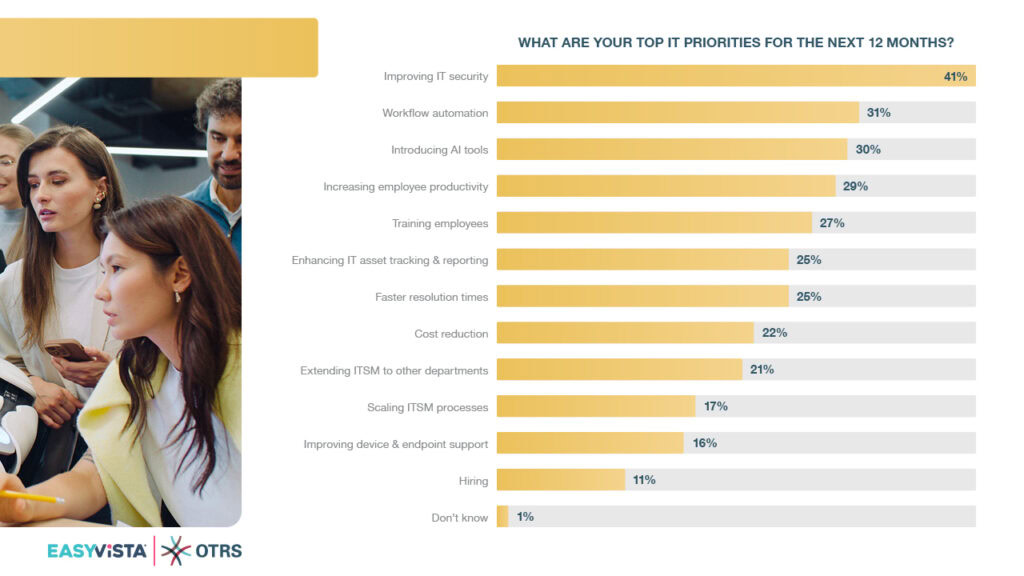
The most important priority for most is improving IT security: 41 percent of surveyed SME representatives assign it the highest importance for 2026, followed by workflow automation (31 percent), the introduction of AI tools (30 percent), and increased employee productivity (29 percent).
This points to the manifold challenges of hybrid environments and data protection on the one hand, but also clearly to a performance orientation on the other. When companies invest, they expect clear improvements.
Companies Want to Invest More in Employees
It is noteworthy that not only tools, software solutions, and features are in focus, but also people: 27 percent of respondents consider employee training an important priority. This makes sense and shows foresight. After all, even the best software solutions have only limited impact if the employees responsible for them do not know them well enough or do not know how to unlock their full potential.
Fittingly, 62 percent of respondents see training and education as an important factor in improving their ITSM practices. This suggests that many employees are overwhelmed by tools and software or at least unable to fully exploit their potential.
Cost-Benefit Ratio: Efficiency Counts
A full 56 percent see easy-to-use AI and automation functions as the key to optimizing their ITSM practices. Additionally, 48 percent cite access to affordable software.
In summary, advanced, user-friendly solutions and features at manageable costs are required for employees to use them effectively. This is precisely the focus for 2026: a coherent cost-benefit ratio that moves companies forward. Ideally, tools are inexpensive, ruthlessly effective, and used by knowledgeable, well-trained employees who handle them skillfully.
Thus, efficiency becomes the decisive maxim: it consists of various components that, working together, can truly make a difference. Companies that want to make a decisive impact with their IT in 2026 must look at the big picture. Holistically and iteratively, IT can move forward even with a limited budget (more on this below).
Best Practices: The Path to Return on Investment (ROI)
Implementing a good, affordable software solution, introducing advanced AI and automation functions, and training employees effectively – in practice, though this is often not easy. Even if the direction is clear, decision-makers still face the question of how to use their often limited IT budget in 2026 as effectively as possible to achieve their goals.
The following are several helpful practices that support making the most effective use of the IT budget.
#1: Work with Your Own Maturity Level
When the IT budget is limited, good, granular approaches matter even more. For example, targeted and highly value-oriented ITSM can be best initiated when the IT team knows exactly where it stands and which steps it needs to take.
These insights are provided by a maturity assessment, which can be carried out quite easily. Based on various dimensions – such as processes, governance and strategy, or technology and tools – the next logical steps become clear to align ITSM with the achievement of relevant overarching business goals.
Once the decision to invest in a new software solution has been made on this basis, the path to a positive ROI becomes significantly easier.
#2: View IT Costs Holistically
Costs are not just costs. There are different cost factors and value drivers that together should result not in pure expenses but in investments with generous returns. When acquiring a software solution, many companies focus solely on the price. However, this is only part of the picture. Holistic concepts such as Total Cost of Ownership (TCO) are more suitable for providing clarity on all costs throughout the entire lifecycle. This is also the task of focused IT asset management.
Decision-makers should also examine the existing IT infrastructure with a cost- and value-oriented mindset and retire tools and applications that primarily cause costs and provide little value. For example, many companies unnecessarily pay for licenses that almost no one uses. On the other hand, fair models such as “Concurrent Agents” already provide significant cost advantages. In this model, companies pay only for as many agents as are working in the system at any given time.
#3: Implement AI Gradually and Based on Needs
Many companies are eager to keep pace with the AI revolution – a correct mindset. After all, our survey data also shows that AI functions matter more in 2026. However, with budget intelligence in mind, it is important not to launch a large-scale AI revolution within the company. Used indiscriminately, AI quickly becomes a pure cost factor that does not bring the expected efficiency gains.
Instead, the focus must be on where AI can make the biggest difference in IT operations. Primarily in these areas, corresponding applications can be used gradually and experimentally. For example, AI-based summaries in ticket systems can deliver enormous advantages, especially for extensive histories and conversations.
Flexible offerings such as booking individual AI services are an easy way to implement this incremental approach.
#4: Support Employees
Training as well as continuing education for employees are among the key factors currently prioritized by small and medium-sized enterprises. However, this area is highly individual: employees often need to apply knowledge in very specific ways and have very different needs regarding training initiatives.
Therefore, companies must accompany and support employees individually. This works when leaders determine together with employees which courses and training sessions are suitable and effective – for example through feedback, assessments, regular exchanges, or simply daily work life. Standard training for everyone only makes sense in broadly applied transitions.
#5: Automate Recurring Tasks as Much as Possible
Automation is also a prominent focus according to our “The State of SMB IT for 2026” report. Standard tasks that recur continuously consume a lot of time — often unnecessarily so. The major advantage: a few simple automations already provide significant time savings and productivity gains, which in turn improve the return on the IT budget used.
Automating individual workflows and setting up standard notifications are good first steps. Additionally, a targeted knowledge base with instructions, descriptions, and how-to articles can be built as an important resource for support cases. Furthermore, companies can strengthen self-service through measures such as integrating AI chatbots, user forums, or updated FAQ pages.
The central goal is always to relieve service and support staff so they can focus more on value-creating tasks with tangible benefits.
Conclusion: Investing Pays Off — Even With a Tight IT Budget
There is clearly budget pressure in IT. Small and medium-sized enterprises in particular must be thrifty. Instead of radical cost-cutting, carefully chosen investments are usually the better choice. When possible, companies should invest strategically, as this is the only way to remain competitive and cost-efficient in the medium and long term.
The calculation is simple: through smart selection – for example of software solutions and advanced features – a clearly positive return on investment (ROI) becomes apparent after a short time. Key indicators include employee productivity, performance improvements, customer satisfaction, or the degree of automation achieved. This allows teams to accomplish a lot even with relatively small manpower and gain substantial time savings, especially in IT support.
Learn how you can get more out of your IT budget with OTRS software solutions.